In sectors including automation, automotive, appliances, and renewable energy, electric motors are essential. The stator and rotor lamination stacks are the two fundamental parts. While often overlooked, these parts are vital for motor efficiency and longevity. Understanding their differences and roles helps engineers and buyers make informed decisions when selecting or comparing motors.
What Are the Electric Motor Stator and Rotor?
Before diving into lamination stacks specifically, it helps to clarify the broader roles of the stator and rotor in an electric motor.
There are usually two primary components to an electric motor:
- Stator: The stationary component that surrounds the rotor and houses electrical windings. It is responsible for establishing magnetic fields that drive motor operation.
- Rotor: The rotating component that spins within the stator’s magnetic field and provides the mechanical output. It is mounted on the motor shaft and interacts dynamically with the magnetic field created by the stator.
In all motor designs, the stator creates a magnetic field, and the rotor responds by turning to generate mechanical energy. The construction of each part impacts efficiency, power, noise, heat, and reliability.
Why Are Lamination Stacks Used and What Are They?
Both the stator and the rotor are commonly built from stacks of thin metallic sheets or laminations. These lamination stacks form the magnetic cores of each component.
Why are laminations used instead of solid metal cores? The answer lies in electrical and magnetic performance.
When metal is exposed to a changing magnetic field, eddy currents are induced, causing heat and energy loss. To reduce this, engineers use laminated stacks of insulated electrical steel, which interrupt eddy currents and improve efficiency.
Lamination stacks control magnetic flow and minimize unwanted currents, ensuring efficient operation, lower heating, and reduced energy waste in high-performance motors.
Structural Differences: Stator vs. Rotor Lamination Stacks
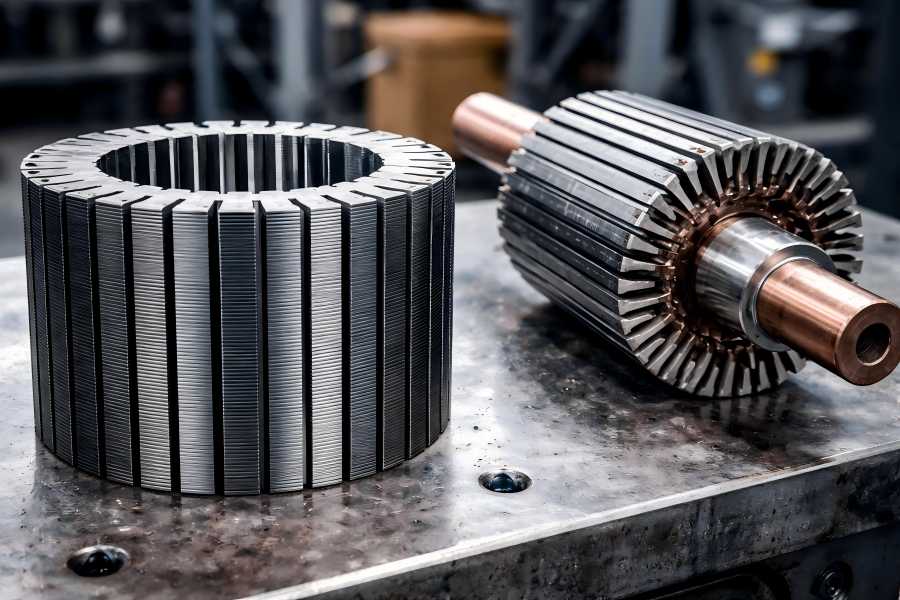
Although both stator and rotor lamination stacks are made from similar materials and serve the purpose of guiding magnetic flux, their structures differ substantially due to their distinct roles.
Stator Lamination Stack Structure
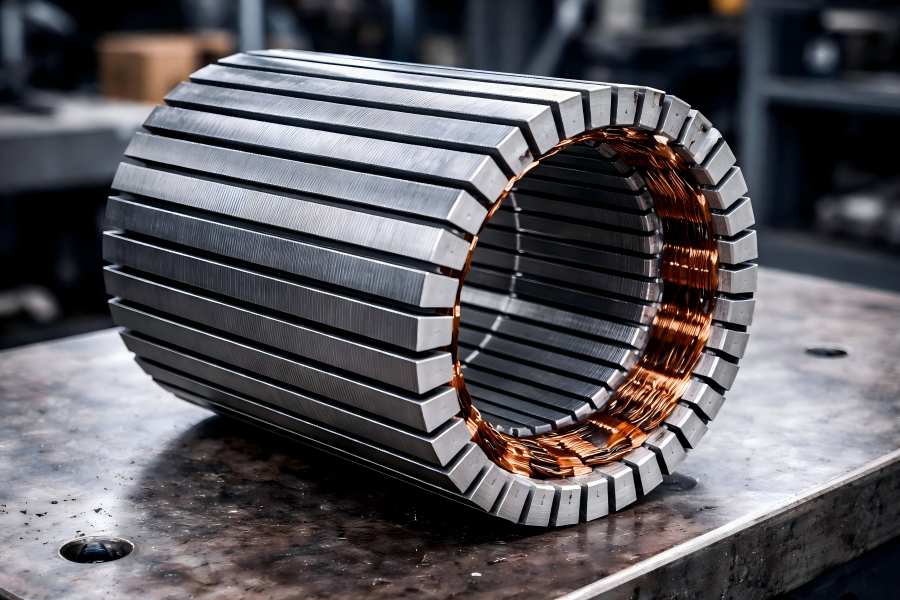
The stator lamination stack typically forms a hollow cylinder that wraps around the motor’s internal space. It consists of multiple thin laminations made from electrical steel. Each lamination features precisely cut shapes that include long, narrow slots on the inside surface. These slots are designed to house the stator’s winding coils, which carry the electrical current necessary to produce magnetic fields.
Because the stator must produce a stable magnetic field, its laminations are arranged to maximize magnetic permeability and reduce losses. The stator’s outer dimensions are generally larger than the rotor’s because it encloses the entire motor core.
Rotor Lamination Stack Structure
The rotor lamination stack, by contrast, is smaller in diameter and fits inside the stator. Packed onto the motor shaft, the rotor stack bears the mechanical forces of rotation. Its laminations also contain slots, but these are engineered to host features such as conductor bars or permanent magnets, depending on the type of motor.
In many induction motors, for example, the rotor stack contains slots filled with conductive elements (often aluminum or copper bars) that interact with the stator’s magnetic field to induce currents and develop torque. In permanent magnet motors, rotor laminations are designed to securely hold magnets.
The design differences between stator and rotor stacks are essential because each part must meet unique mechanical and electromagnetic demands: the stator must generate strong, uniform fields; the rotor must be balanced, durable under spin, and configured to convert magnetic interaction into motion.
Functional Differences
The primary function of the stator lamination stack is to support the conversion of electrical energy into a dynamic magnetic field. When alternating current flows through the winding coils housed in the stator slots, it generates a varying magnetic field that extends inward toward the rotor.
By contrast, the primary function of the rotor lamination stack is to interact with the stator’s magnetic field in a way that produces rotational motion. This interaction induces currents in the rotor’s conductive elements (in induction motors) or couples directly with permanent magnets (in synchronous motors), generating torque that causes the shaft to turn.
In essence:
- The stator creates and shapes the magnetic field.
- The rotor responds to it to produce mechanical movement.
The synergy between the magnetic behavior of each lamination stack and its physical orientation allows an electric motor to perform its core function: converting electrical energy to mechanical power.
Production Processes for Lamination Stacks
The manufacturing of both stator and rotor lamination stacks involves precision work. Although the basic principles of lamination are similar, specific steps vary depending on design requirements and production volumes.
Material Selection
Both stator and rotor laminations are typically made from electrical steel, a specialized alloy designed for high magnetic permeability and reduced core loss. In some high-performance applications, alternative materials like iron–cobalt alloys may be used to achieve even better magnetic properties.
Cutting Processes
Key production steps include shaping the individual laminations. Two common methods are:
- Stamping: Rapid and efficient for high-volume production. A die cuts the required lamination pattern from steel sheets with high repeatability.
- Laser Cutting and Precision Techniques: Ideal for complex geometries or low-to-medium volume production. Lasers or other high-precision tools ensure accurate profiles that match design specifications.
After cutting, each lamination is coated with a thin layer of insulation to minimize electrical contact between sheets once stacked. This maximizes the eddy-current reduction benefit.
Stacking and Bonding
Individual laminations are stacked to form the final core structure. For the stator, this stack forms a stable, stationary structure into which windings are inserted. For the rotor, laminations are aligned and secured on the rotor shaft. Fastening methods vary and may include adhesives, welding, riveting, or mechanical compression, depending on design constraints and performance requirements.
The stacked assembly then undergoes inspections and quality control procedures to ensure it meets dimensional and electromagnetic performance criteria.
Magnetic Properties and Their Impact
The magnetic properties of lamination materials directly influence motor performance. Ideal lamination materials exhibit high magnetic permeability, low core loss, and good saturation characteristics. These properties allow magnetic flux to flow readily with minimal energy loss, contributing to motor efficiency and power density.
By selecting appropriate materials and controlling lamination thickness and stacking quality, manufacturers can tune the motor’s response for specific performance goals—whether efficiency, torque, speed, or thermal behavior.
Applications
Electric motors using laminated stators and rotors are ubiquitous across industries and application scales. These include:
Industrial Machinery
Heavy-duty motors in manufacturing equipment rely on robust lamination stacks to withstand continuous operation and high magnetic flux conditions.
HVAC and Climate Control Systems
Efficient stator and rotor designs help HVAC systems achieve high energy efficiency ratings while maintaining quiet operation.
Electric Vehicles (EVs)
EV motors demand high power density and efficiency, making quality lamination stacks crucial to battery life and vehicle performance.
Power Tools and Appliances
Smaller motors in tools and household devices benefit from laminated cores that reduce heat and improve durability.
Renewable Energy Systems
Generators and turbine drives also depend on laminated stators and rotors for efficient energy conversion over prolonged duty cycles.
Across these applications, the core difference remains the same: stators generate fields efficiently, and rotors react to create motion—all enabled by carefully engineered lamination stacks.