
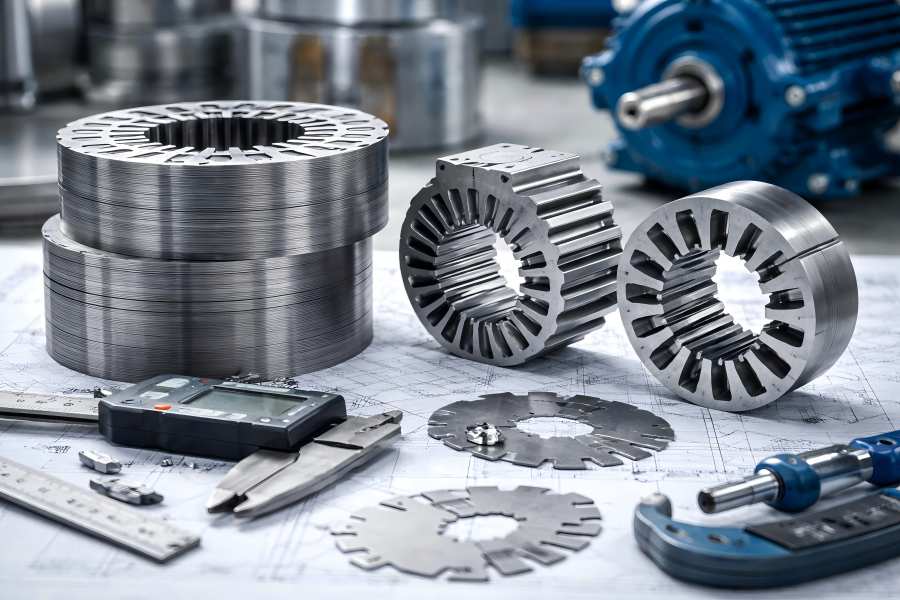
Motor laminations are integral components in the design of electric motors, particularly in minimizing energy losses and improving motor efficiency. As motors evolve in terms of power density and performance, understanding the impact of lamination thickness has become crucial.
What Are Motor Laminations?
Motor laminations are thin sheets of magnetic material stacked to form the core of a motor’s stator or rotor. Their main function is to reduce energy losses caused by eddy currents, which are loops of electrical current induced by a changing magnetic field, leading to wasted energy in the form of heat.
By using laminated cores with insulating layers, typically varnish, manufacturers can minimize these losses and improve motor efficiency. The thickness of the laminations plays a critical role in determining energy loss, as it influences eddy current formation.
Different motor types require different lamination designs. For example, stator laminations are arranged in cylindrical layers, while rotor laminations fit within the stator. The choice of thickness depends on the motor’s type, operating conditions, and materials.
The Function of Lamination Thickness
The thickness of motor laminations significantly impacts the magnetic flux passing through the motor core. Magnetic flux indicates the intensity of the magnetic field as it moves through the motor’s core. When laminations are thicker, they can accommodate more magnetic flux; however, this also increases the likelihood of higher eddy current losses.
Thicker laminations tend to have lower resistance to the flow of magnetic flux, which can be beneficial in specific situations where higher flux density is required. However, the increased thickness also provides a larger cross-sectional area for the eddy currents to form, thus leading to greater energy losses.
Conversely, thinner laminations have higher resistance to eddy currents, which reduces energy losses. The trade-off, however, is that thinner laminations may not support as much magnetic flux as thicker laminations, potentially affecting the motor’s performance in high-power applications.
Factors Influencing Lamination Thickness
Several factors influence the optimal thickness of motor laminations, including:
Core Material:
The material used for motor laminations significantly affects the choice of thickness. Because silicon steel is inexpensive and has good magnetic characteristics, it is a common material. The higher the silicon content, the more efficiently the motor can handle magnetic flux, meaning that thinner laminations can be used.
Frequency of Operation:
The required lamination thickness is mostly dependent on a motor’s operating frequency. Higher operating frequencies tend to generate more heat and greater eddy current losses. In such cases, thinner laminations may be preferred to minimize these losses.
Motor Type:
Depending on their design and intended use, different motor types require varying lamination thicknesses. For instance, permanent magnet synchronous motors (PMSMs) often require thinner laminations to achieve higher efficiency at low speeds. In contrast, induction motors may use slightly thicker laminations to handle higher power densities.
Trade-offs of Thicker vs. Thinner Laminations
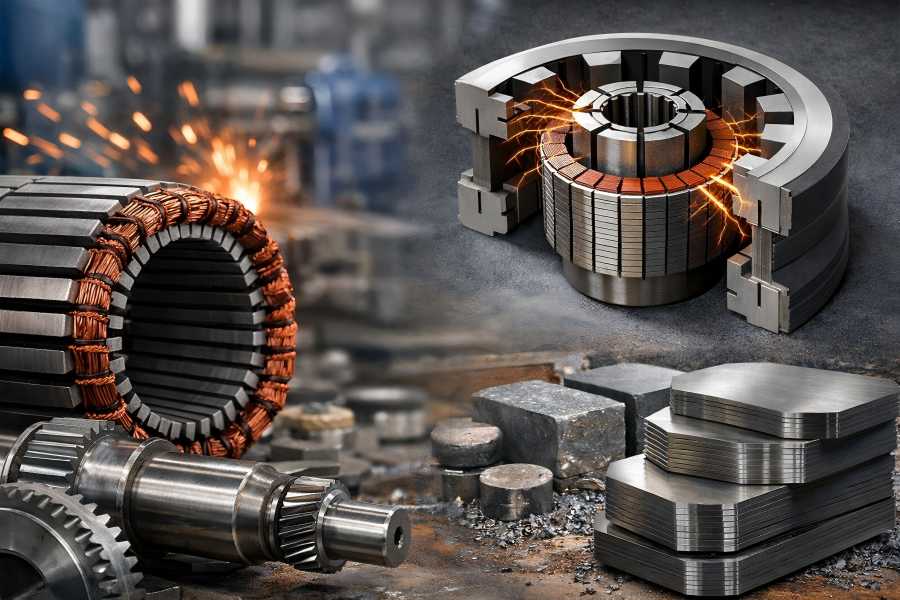
Choosing between thicker and thinner laminations involves balancing performance, cost, and efficiency.
Benefits of Thicker Laminations:
- Improved Magnetic Flux Capacity: Thicker laminations can support higher magnetic flux densities, which is advantageous in motors that need to produce more torque or handle higher loads.
- Mechanical Strength: Thicker laminations are mechanically stronger and can provide more robust support for the motor’s structure, making them suitable for heavy-duty applications.
- Lower Material Cost: Although thicker laminations result in higher eddy current losses, they are generally easier to manufacture, leading to lower production costs.
Challenges of Thicker Laminations:
- Increased Eddy Current Losses: The larger cross-sectional area of thicker laminations allows for more substantial eddy currents, leading to increased energy waste and heat generation.
- Reduced Efficiency: The higher the thickness, the more heat is generated, which can negatively impact the motor’s overall efficiency and lifespan.
Benefits of Thinner Laminations:
- Reduced Eddy Current Losses: Thinner laminations reduce the area through which eddy currents can flow, resulting in lower energy losses and improved motor efficiency.
- Better Cooling: The reduced heat generation allows for better cooling of the motor, enhancing its reliability and longevity.
- Improved Efficiency: Thinner laminations are often favored in motors where efficiency is paramount, especially in electric vehicles and precision equipment.
Challenges of Thinner Laminations:
- Lower Flux Capacity: Thinner laminations may not support as much magnetic flux as thicker laminations, which can reduce the overall performance of the motor in high-power applications.
- Higher Manufacturing Costs: While thinner laminations offer superior efficiency, they require more precise manufacturing, which can increase production costs.
How Lamination Thickness Affects Motor Performance
Lamination thickness plays a vital role in various aspects of motor performance, including efficiency, torque production, and heat generation. Here are some ways lamination thickness affects motor performance:
Efficiency:
In motors that use thinner laminations, energy losses due to eddy currents are minimized, leading to better overall efficiency. This is particularly important in applications such as electric vehicles, where efficiency is crucial for extending battery life.
Torque Production:
Thicker laminations can support higher magnetic flux densities, which can enhance torque production, making them ideal for high-torque applications. However, the efficiency trade-off means that thinner laminations may be better suited for applications where efficiency is more critical than raw torque.
Heat Generation:
Lamination thickness has a direct impact on heat generation. Thicker laminations tend to generate more heat due to higher eddy current losses, which can lead to overheating and reduced motor performance over time. Conversely, thinner laminations generate less heat, guaranteeing that the motor runs at ideal temperatures.
Manufacturing Techniques for Laminations
The manufacturing process for motor laminations is a critical aspect of determining lamination thickness. Common manufacturing techniques include:
Stamping:
Motor laminations are often manufactured using stamping techniques, where a die is used to cut the laminations from sheets of magnetic material. This method is commonly used for high-volume production and allows for precise control over the thickness of the laminations.
Laser Cutting:
Another technique for producing thin laminations with extreme precision is laser cutting. It allows for very fine tolerances, making it ideal for applications that require very thin laminations to reduce eddy current losses.
Lamination Insulation:
During the manufacturing process, a thin layer of insulation is applied to the laminations to prevent the formation of unwanted eddy currents. The thickness of this insulation also affects the overall efficiency of the motor.
Industry Standards and Specifications
Motor lamination thickness follows industry standards, including those from the IEC and NEMA. These standards ensure that motors meet the necessary performance and safety criteria while also allowing for consistency in production.
Common Thickness Values:
- For small motors, laminations typically range from 0.2 mm to 0.5 mm in thickness.
- For larger motors, laminations may range from 0.5 mm to 1.0 mm, depending on the required torque and power output.
Standards for lamination thickness also vary depending on the motor’s application. For instance, motors used in industrial equipment may require thicker laminations for higher mechanical strength, while motors in electric vehicles may prioritize thinner laminations for improved efficiency.
Case Studies
Here are a few case studies showcasing how different lamination thicknesses are optimized for specific applications:
Electric Vehicles:
In electric vehicles, motor efficiency is paramount to maximize battery life. These motors frequently use thinner laminations to boost efficiency and lower energy losses. However, the motor design is optimized to ensure that the flux capacity is sufficient for the required power output.
Industrial Motors:
In industrial motors, thicker laminations may be used to handle higher loads and produce greater torque. These motors are often designed for high power density, where the trade-off between efficiency and performance is more acceptable.
Precision Equipment:
For applications requiring high precision, such as robotics and CNC machines, thinner laminations are typically favored due to their efficiency. These applications often require motors that can run at variable speeds with minimal heat generation.
| Lamination Thickness (mm) | Application | Key Benefit | Trade-off |
| 0.2 – 0.5 | Electric vehicles, precision equipment | High efficiency, low energy loss | Limited torque capacity |
| 0.5 – 1.0 | Industrial motors, high-power applications | High torque production, mechanical strength | Increased eddy current losses, less efficient |
| 1.0 – 1.5 | Heavy-duty industrial motors | Enhanced mechanical strength, durability | Increased heat generation and energy waste |