
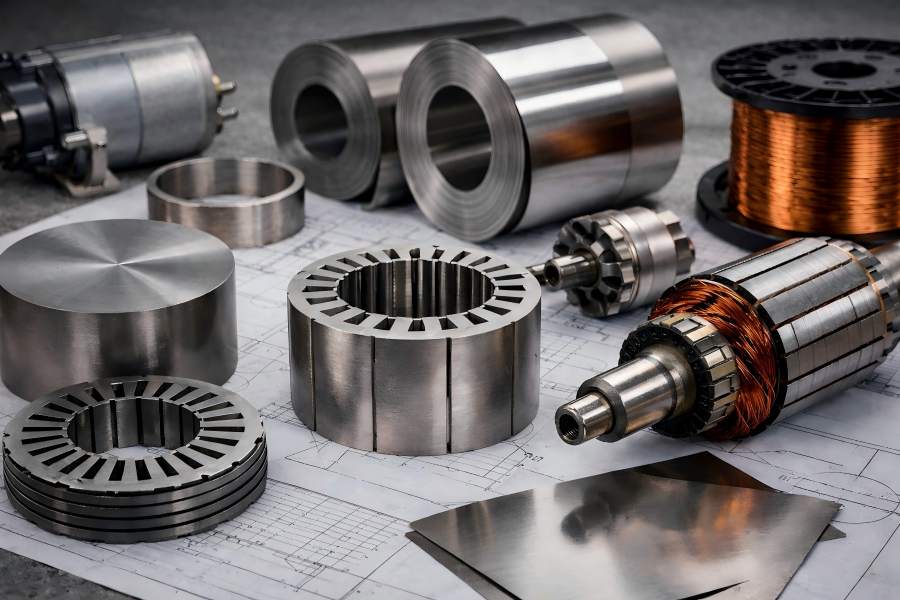
Electric motors and generators power modern equipment across industries, transportation, and energy systems. The motor lamination steel grade used in the core plays a critical role in efficiency, loss reduction, and long-term reliability.
Understanding Motor Lamination Steel Grades
At the heart of every electric motor and generator, the motor core is built from stacked thin steel laminations that precisely channel magnetic flux and make efficient energy conversion possible.
Unlike ordinary structural steel, lamination steel is specially engineered to satisfy stringent magnetic and electrical performance requirements.
Why Laminations Instead of Solid Steel?
The magnetic field in the core of a motor or generator changes when alternating current passes through its windings. A solid steel core would allow eddy currents to form, causing excessive heat generation and energy loss.
To combat this:
- The core is made from thin sheets rather than a solid block.
- Each sheet is coated with an insulating layer to prevent electrical contact.
- The stack of insulated sheets drastically reduces eddy current loss.
Core performance depends not only on laminated construction but also on selecting the proper steel grade optimized for magnetic efficiency, manufacturability, thermal performance, and cost.
What Defines a Lamination Steel Grade?
A lamination steel grade encompasses:
- Chemical composition (e.g., silicon content, alloying elements)
- Thickness (gauge of the sheet)
- Magnetic properties (core loss and permeability)
- Mechanical properties (ductility, edge quality after forming)
- Surface coating type (for insulation, corrosion resistance, weldability)
Standards such as ASTM, EN, JIS, and GB define acceptable ranges for these properties, enabling designers and buyers to ensure consistency and interchangeability.
Common Steel Grades and Their Properties
Motor lamination steels are mainly non-oriented electrical steels, offering uniform magnetic properties in all directions, which makes them ideal for rotating machines with constantly changing magnetic flux.
Main Categories of Lamination Steels
- Silicon Electrical Steels: The most common and cost-effective.
- High-Performance Alloys (Cobalt, Nickel): Used in specialty, high-efficiency, and high-temperature applications.
- Ultra-thin grades: For high-speed and inverter-driven applications.
These steels vary mainly in core loss levels, thickness, and magnetic saturation, which directly impact efficiency and performance.
| Grade Code (Example) | Thickness (mm) | Core Loss Level | Typical Application |
| 50W470 / M47 | 0.50 | Standard | General industrial motors |
| 35W300 / M36 | 0.35 | Low | Efficient drives & pumps |
| 30W230 / M27 | 0.30 | Lower | EV traction motors, inverters |
| 27W150 | 0.27 | Very low | High efficiency, high frequency |
| 20W120 | 0.20 | Ultra-low | Aerospace & high-speed |
| Co-Alloy Steel | 0.20–0.35 | Premium low loss | High performance / high saturation |
| Ni-Alloy Steel | Variable | Low hysteresis | Precision, low-noise motors |
Notes: Codes vary by standard (ASTM/EN/JIS/GB). “Wxxx” grades are common in Asian standards, while “Mxx” grades are typical in ASTM/EN.
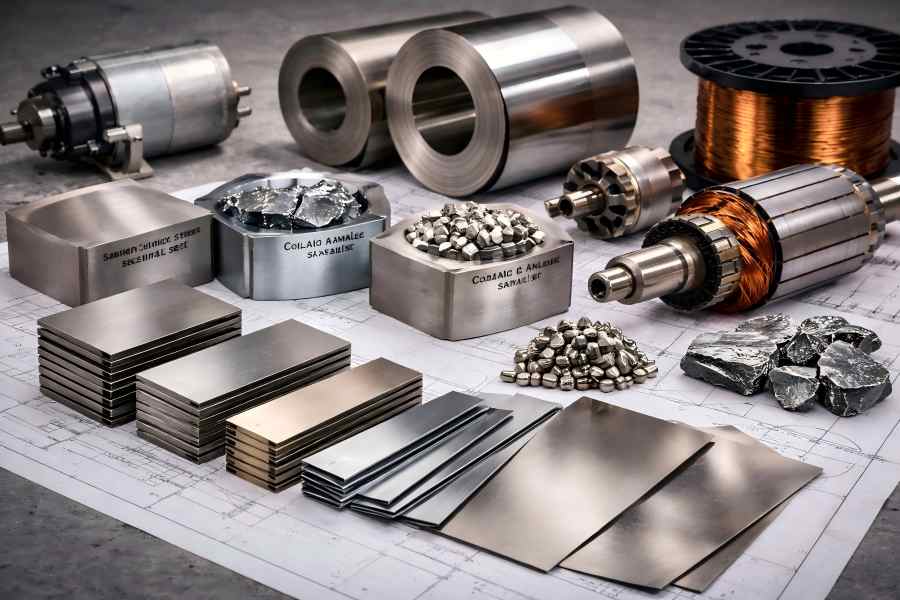
Silicon Electrical Steels
Silicon steels are the workhorse materials in lamination applications. Adding silicon (typically 1.0–3.5%) to iron increases electrical resistivity, which:
- Reduces eddy current loss
- Improves magnetic permeability
- Reduces hysteresis loss
This balance of performance and cost makes silicon steels ideal for most motors and generators.
High-Performance Alloys
- Cobalt Alloy Steels: Higher saturation flux density (up to ~2.4 T), excellent high-frequency performance, and thermal stability. Typically used in aerospace, defense, and specialty high-speed motors.
- Nickel Alloy Steels: Very high magnetic permeability and low hysteresis; often used in precision or noise-sensitive applications, but with higher cost and lower saturation.
Ultra-thin grades (≤0.27 mm) reduce eddy current losses even further and are preferred for inverter-driven and high-speed machines where frequency and skin effect must be considered.
Mechanical and Physical Properties of Steel
Understanding the mechanical and physical properties of lamination steels explains why some grades are chosen for certain applications and how they influence performance.
| Property | Silicon Steel | Cobalt Alloy Steel | Nickel Alloy Steel |
| Saturation Flux Density (T) | ~1.5–2.0 | ~2.2–2.4 (high) | ~0.8–1.6 |
| Magnetic Permeability | Good | Very High | Extremely High |
| Hysteresis Loss | Moderate to Low | Low | Very Low |
| Eddy Current Loss | Moderate | Low | Moderate to Low |
| Electrical Resistivity | Moderate | High | Moderate |
| Operating Temperature (°C) | Up to ~200 | Up to ~300 | Up to ~250 |
| Ease of Stamping / Cutting | Good | Moderate | Moderate to Difficult |
| Surface Coating Compatibility | Good | Moderate | Moderate to Low |
| Material Cost | Low to Moderate | High | High |
Applications of Different Grade Steel
Motor and generator designs vary by application, speed range, required efficiency, operating environment, and cost targets. The right lamination steel grade depends on these factors.
Industrial Motors
Industrial motors frequently run constantly in settings where total cost of ownership and dependability are important. Thicker sheets like 0.50 mm are easier to handle, less prone to mechanical distortion during stamping, and provide satisfactory efficiency for general-purpose applications.
Typical Grades: 50W470, 35W300
Characteristics:
- Affordable and easy to process
- Good performance at 50/60 Hz mains frequency
- Moderate thickness (0.35–0.50 mm)
Example Uses:
- HVAC blowers and pumps
- Conveyor drives
- Fans, compressors, and base-load motors
Electric Vehicle (EV) Traction Motors
EV traction motors operate at high electrical frequencies due to inverter drives and often run across a broad speed range. This places greater demands on the magnetic properties of the core. Lower-loss steels reduce heat generation, improving range and thermal reliability in compact designs.
Typical Grades: 30W230, 27W150
Characteristics:
- Thin laminations (0.27–0.30 mm)
- Ultra-low core loss at higher frequencies
- Often paired with advanced insulating coatings
Example Uses:
- Passenger EV traction drives
- Hybrid vehicle motors
- High-performance electric sports cars
Generators
Generators must produce steady electrical output across various loads and environmental conditions. While efficiency is important, stability under continuous duty and excellent thermal performance are primary considerations.
Typical Grades: 35W300, 30W230, sometimes thicker or specialized steels
Characteristics:
- Designed for continuous operation and reliability
- Balanced performance between thermal behavior and efficiency
Example Uses:
- Solar and wind turbine generators
- Industrial backup generators
- Power plant alternators
High-Speed and Aerospace Motors
In aerospace, defense, and specialized manufacturing, motors must operate at very high speeds with minimal losses and extreme reliability. Premium alloys such as cobalt steels provide performance gains that outweigh higher raw material and processing costs.
Typical Grades: 20W120, Cobalt/Nickel Alloys
Characteristics:
- Ultra-low loss at very high frequencies
- High saturation and permeability
- Often premium material, premium cost
Example Uses:
- Aerospace actuators and turbines
- High-speed CNC spindles
- Precision servo systems
Steel Alloy Comparison with Other Metals
| Material | Magnetic Use | Core Loss Behavior | Typical Role in Motor |
| Silicon Steel | Core laminations | Low to very low (grade dependent) | Standard motor and generator cores |
| Cobalt Alloy Steel | Premium cores | Very low at high frequency | High performance/aerospace |
| Nickel Alloy Steel | Precision cores | Very low hysteresis | Precision, low-noise applications |
| Solid Iron | Magnetic, high permeability | High eddy current loss | Not suitable for AC cores |
| Ferrites | Magnetic, high freq | Very low at high freq | Inductors, transformers (limited) |
| Aluminum / Copper | Non-magnetic conductors | N/A | Windings, rotor cages, housings |