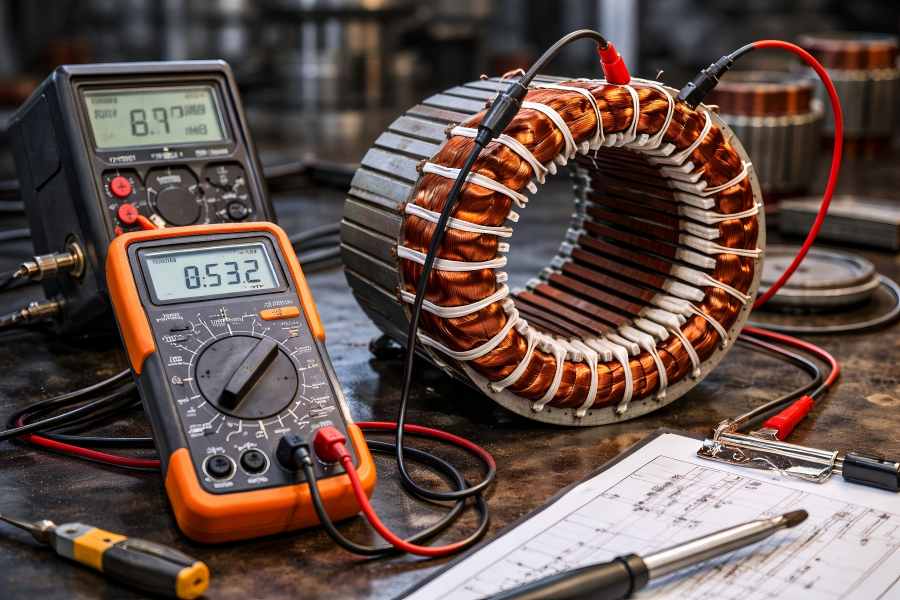
From manufacturing facilities to household products, motors are crucial parts of many different sectors. The windings in motors, both in the stator and rotor, play a crucial role in their operation. When motor windings fail, it can lead to inefficiency, overheating, and, in the worst-case scenario, complete motor failure. Detecting faulty windings early is key to ensuring that motors remain reliable and operate at peak efficiency.
What Are Motor Windings?
Motor windings are typically made from copper wire coated with insulating material. They are wound into coils and then placed in the stator or rotor, where they generate magnetic fields that allow the motor to function.
The motor winding design can vary depending on the type of motor. For example, in an induction motor, the stator windings generate a rotating magnetic field, which induces current in the rotor windings, creating torque. In contrast, both the rotor and stator of a synchronous motor contain windings.
Windings frequently fail as a result of manufacturing flaws, contamination, vibration damage, overheating, or insulation failure. To keep them in good shape and avoid malfunctions, routine inspection and maintenance are essential.
Symptoms of Faulty Motor Windings
Faulty windings often manifest in several ways, and early detection can help prevent more severe motor damage. The most common symptoms of faulty motor windings include:
Unusual Motor Noises
When windings are damaged or shorted, it can lead to odd noises such as buzzing or humming sounds. These noises often indicate electrical imbalances, which are a sign of winding faults.
Overheating
If a motor is overheating, it can be a sign of faulty windings. Overheating occurs when current is unable to flow efficiently through the windings due to insulation breakdown or other issues.
Reduced Motor Performance
A motor with faulty windings may exhibit reduced performance, including slower speeds, less torque, or failure to start. Energy usage frequently rises in tandem with these performance problems.
Electrical Issues
Faulty windings can also trigger electrical issues such as tripped circuit breakers, blown fuses, or irregular voltage readings. These problems arise when windings create short circuits or other electrical imbalances.
Tools and Equipment Needed for Detection
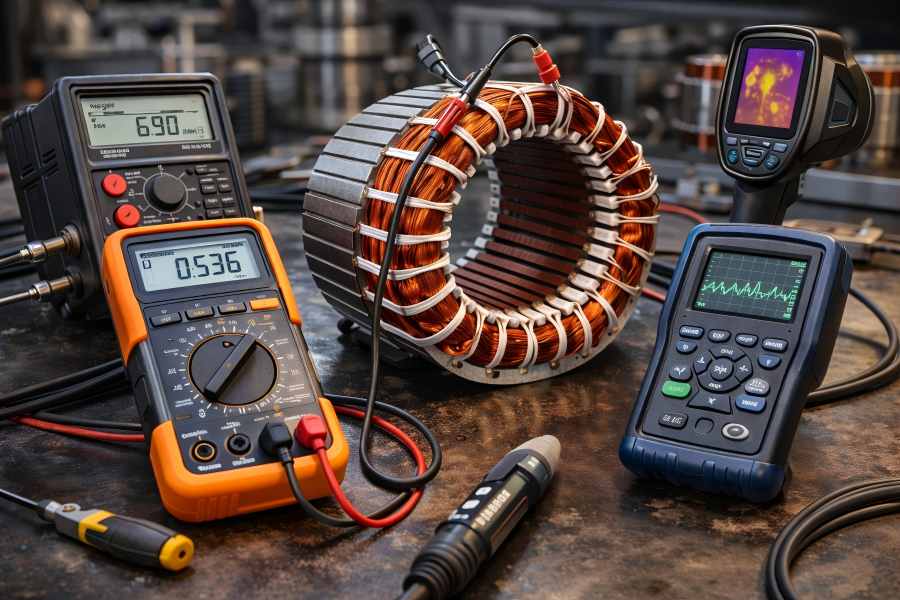
Detecting faulty windings requires specific tools and equipment. Among the most often utilized instruments are:
Multimeter
The motor windings’ voltage, resistance, and continuity are checked using a multimeter. It is a crucial instrument for identifying electrical problems.
Insulation Resistance Tester (Megger)
This device measures the insulation resistance of motor windings, helping to detect any breakdowns in the insulation.
Winding Resistance Tester
A winding resistance tester measures the resistance of individual windings, assisting in identifying imbalances and faults.
Thermal Camera
A thermal camera allows for a non-contact method of detecting hot spots in the motor, which may indicate problems with the windings.
Vibration Analyzer
This tool helps detect abnormal vibrations in the motor, which can be caused by imbalances in the windings.
Step-by-Step Guide to Detect Faulty Windings
Step 1: Visual Inspection
A comprehensive visual examination of the motor is the first step in identifying defective windings. Check for any obvious indications of damage, like:
- Discoloration: A burn mark or discoloration on the windings indicates overheating and potential insulation breakdown.
- Exposed Wires: If the insulation on the windings is damaged, it can expose the wires, leading to short circuits or grounding.
- Fraying or Cracks: Inspect the winding for any fraying, cracking, or physical damage that could impair the motor’s performance.
A visual inspection may not always reveal internal issues, but it can provide important clues and help identify areas for further testing.
Step 2: Testing for Insulation Resistance
The state of the insulation surrounding the motor windings is assessed using the insulation resistance test. This is an important test for detecting short circuits or leakage caused by insulation failure.
- How to perform the test: Use a megger to measure resistance between the windings and ground, applying high voltage to detect insulation breakdown.
- What to look for: If the resistance is below the manufacturer’s recommended value, it indicates that the insulation is compromised, and the windings may be faulty.
| Test Result | Interpretation |
| >100 MΩ | Healthy insulation, no issues |
| 1–100 MΩ | Warning signs of insulation wear |
| <1 MΩ | Severe insulation failure, faulty windings |
Step 3: Continuity Testing
Continuity testing involves checking the windings for open circuits or shorts. This test can be carried out with a multimeter.
- How to perform the test: Set the multimeter to the continuity setting and connect the probes to the two ends of the winding. If the meter beeps, continuity is present.
- What to look for: If the multimeter does not beep or gives an infinite resistance reading, the winding is open and needs to be replaced. If there’s an unexpected short, it may indicate a problem with the winding.
Step 4: Resistance Testing
Resistance testing helps identify variations in the resistance of individual windings, which can indicate imbalances or faults.
- How to perform the test: Measure the resistance of each winding and compare them. Each winding should have the same resistance under normal conditions.
- What to look for: If the resistance values differ significantly between windings, it suggests that one or more of the windings are damaged or experiencing failure.
| Winding | Expected Resistance (Ω) | Actual Resistance (Ω) | Status |
| Winding 1 | 0.5 | 0.5 | Normal |
| Winding 2 | 0.5 | 0.6 | Faulty |
| Winding 3 | 0.5 | 0.7 | Faulty |
Step 5: Thermal Inspection
Thermal imaging is a helpful technique for locating motor overheating regions that might point to damaged windings.
- How to perform the test: Use a thermal camera to scan the motor while it’s running. Look for hot spots, especially around the windings.
- What to look for: A significant temperature difference between windings suggests that some windings are underperforming or failing due to insulation breakdown.
Step 6: Vibration Analysis (Optional)
Vibration analysis can help identify unbalanced windings or faults that affect the motor’s performance.
- How to perform the test: Attach a vibration sensor to the motor housing and monitor the vibrations while the motor is in operation.
- What to look for: Abnormal vibration patterns can indicate winding imbalances or faults that may not be visible through other diagnostic methods.
Common Faults in Motor Windings
Motor windings can fail in various ways. Some of the most common faults include:
- Open Windings: This occurs when one or more of the windings become disconnected, causing a complete loss of current flow.
- Shorted Windings: Shorted windings occur when the wires inside the windings come into contact with each other or with the ground, causing a short circuit.
- Grounded Windings: When the winding comes into contact with the motor casing or ground, it can cause electrical leakage and inefficient performance.
- Damaged Insulation: The insulation around the winding is designed to prevent short circuits. Over time, heat and wear can degrade this insulation, leading to failure.
Troubleshooting and Fixing Faulty Windings
Once faulty windings are detected, it’s important to determine whether the motor can be repaired or if replacement is necessary. Sometimes the motor just needs to be rewound or have its insulation changed.
For minor faults, repairing the motor may be sufficient, but if the damage is extensive, it may be more cost-effective to replace the motor entirely. Always consult with a professional motor technician for complex issues.
Prevention and Maintenance Tips
Preventing faulty windings starts with proper maintenance and monitoring. Here are some essential pointers:
- Frequent Examinations: To identify problems early, perform routine electrical and visual inspections.
- Proper Ventilation: Ensure that the motor has proper airflow and cooling to prevent overheating.
- Avoid Overloading: Running motors beyond their rated capacity can lead to excessive heat and winding damage.
- Monitor Motor Load: Use load sensors to monitor the motor’s workload and adjust accordingly.
- Use Quality Materials: Ensure that high-quality insulation and wiring materials are used during manufacturing to reduce the risk of failures.