
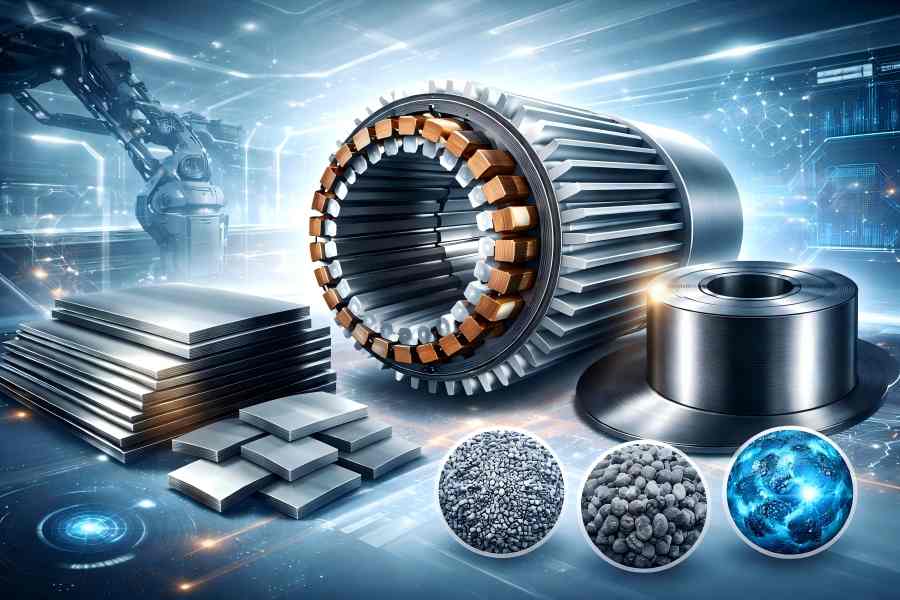
Motor laminations, an integral part of electric motors, are vital for their performance, efficiency, and durability. By reducing energy losses such as eddy currents and improving the motor’s magnetic properties, the materials used in motor laminations significantly influence motor efficiency.
Motor manufacturers are increasingly looking at new and developing materials to enhance their products as sectors move toward more energy-efficient and sustainable technology.
Basics of Motor Lamination Materials
Motor laminations, primarily made from electrical steels, help reduce core losses in the motor. The motor core is formed by stacking thin sheets of material during the lamination process. To lessen eddy current losses, these thin sheets are isolated from one another. The efficiency, magnetic performance, and total cost of the motor are all directly impacted by the material selection.
The most common materials used in motor laminations are:
- Silicon Steel: Traditionally, the backbone of motor cores, this material is valued for its high magnetic permeability and low core loss. It is frequently utilized in high-performance motors found in electric cars (EVs) and industrial machinery.
- Amorphous Steel: Known for its ultra-low core loss, this material is gaining attention for energy-efficient applications. However, its high production cost and lower mechanical strength limit its widespread adoption.
- Soft Magnetic Composites (SMCs): These are gaining traction for their flexibility in forming complex shapes, making them ideal for high-frequency applications and advanced motor designs.
Drivers of Change in Lamination Materials
Several factors are driving the evolution of motor lamination materials:
Rise of Electrification
The need for high-efficiency motors is growing as sectors like transportation and automotive move toward electrification. EV motors, for example, need to be lightweight, durable, and highly efficient. The shift towards cleaner energy sources is pushing manufacturers to adopt advanced materials that can help reduce power losses and enhance motor performance.
Energy Efficiency Standards and Regulations
Globally, governments are enforcing more stringent energy efficiency regulations for electric motors. This regulatory pressure is driving the development of new materials that meet these requirements while still being cost-effective for large-scale production.
Thermal Management and Higher Operating Speeds
Motors are being designed to operate at higher speeds and under higher thermal loads. Lamination materials must therefore provide improved heat resistance and thermal conductivity. This is pushing manufacturers to explore new alloys and composite materials that can withstand these stresses without compromising performance.
Cost Pressures and Supply Chain Considerations
While the demand for advanced materials is growing, manufacturers must balance the cost of raw materials and production processes. Supply chain disruptions, rising raw material costs, and the need for cost-efficient production are forcing manufacturers to find materials that offer both high performance and cost-effectiveness.
Advanced Silicon Steels
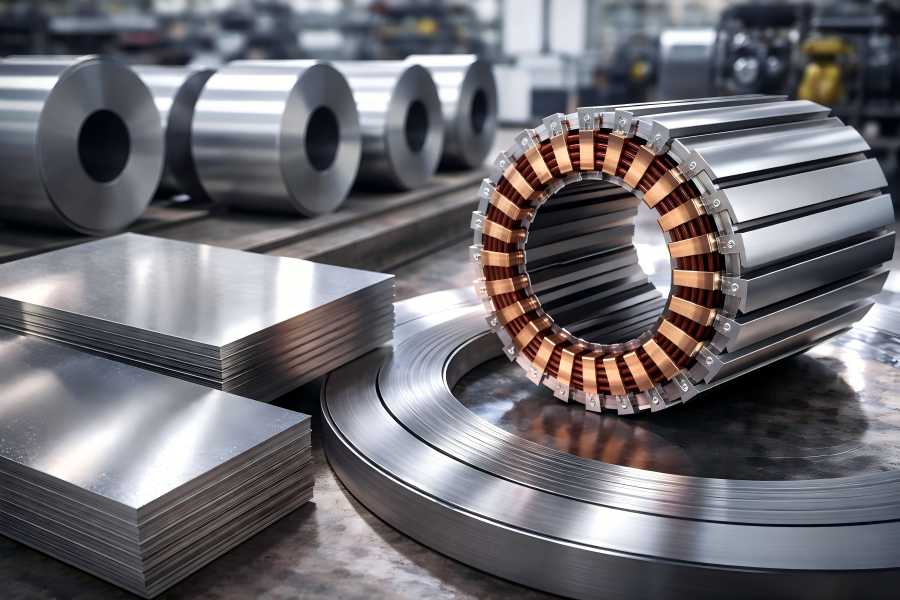
Silicon steel has long been the standard material for motor laminations. However, recent advancements in this material have led to the development of high-grade silicon steels that offer improved performance.
Grain-Oriented Silicon Steel
High-efficiency motors frequently use grain-oriented silicon steel (GOES) because of its exceptional magnetic qualities. The grain orientation enhances the magnetic permeability in one direction, improving motor efficiency. These steels are being further refined with thinner laminations and better insulating coatings to minimize losses.
Non-Oriented Silicon Steel
Non-oriented silicon steel (NOES) is used in applications where motors operate in multiple directions, such as in induction motors. Recent innovations have enhanced the magnetic properties of NOES, making it suitable for higher power applications while still providing cost efficiency.
Table 1: Comparison of Grain-Oriented vs. Non-Oriented Silicon Steel
| Property | Grain-Oriented Steel | Non-Oriented Steel |
| Magnetic Permeability | High (in one direction) | Moderate (multi-directional) |
| Core Loss | Low | Moderate |
| Applications | Transformer cores, EV motors | Induction motors, home appliances |
| Cost | Higher | Lower |
Amorphous and Nanocrystalline Materials
Amorphous and nanocrystalline materials represent a significant departure from traditional motor lamination materials. These materials offer ultra-low core losses and higher magnetic permeability, which can lead to more efficient and compact motor designs.
Amorphous Steel
Amorphous steel, or metallic glass, is made by rapidly cooling molten metal to prevent crystallization, resulting in low core losses and high permeability. It is ideal for energy-efficient applications like transformers and certain motors.
However, the higher manufacturing costs of amorphous materials and their brittleness limit their widespread use in mainstream motor applications. Manufacturers are working on improving the production process to make amorphous materials more cost-effective.
Nanocrystalline Materials
Nanocrystalline materials are made by controlling the size of the crystals within the material to the nanometer scale. Compared to amorphous steel, these materials have even reduced core losses and better mechanical characteristics. However, they are still in the experimental stage for many motor applications due to their high cost and complex manufacturing process.
Soft Magnetic Composites (SMCs)
Soft magnetic composites (SMCs) are a novel approach to motor laminations. SMCs are created by using a polymer binder to bind tiny particles of soft magnetic material. This composite material offers flexibility in motor design because it can be shaped into intricate designs.
SMCs have several advantages over traditional laminated steels:
- Formability: SMCs can be molded into 3D shapes, allowing for more efficient use of space in motor designs.
- High-Frequency Operation: SMCs are ideal for high-frequency applications, such as in the core of electrical machines that operate at high speeds.
However, SMCs still face challenges related to manufacturing scale-up and cost. While they are suitable for low-to-medium-volume applications, their high cost has kept them from being widely adopted in mass-market motors.
Emerging Alloys and High-Entropy Materials
High-entropy alloys (HEAs) are made of five or more elements in nearly equal proportions, offering exceptional mechanical properties like high strength and wear and corrosion resistance, making them promising for high-performance applications.
In the context of motor laminations, HEAs are being researched for their potential to improve magnetic properties and reduce core losses. Although these materials are still in the early stages of development, they hold promise for future use in high-performance electric motors.
Coating and Insulation Innovations
In addition to the materials used for laminations themselves, coatings and insulation technologies are also evolving. Advances in insulating materials are helping to reduce eddy current losses and increase the overall efficiency of electric motors.
Advanced Electrical Insulation Coatings
Coatings that reduce eddy currents are gaining attention as a way to enhance the performance of motor laminations. These coatings can significantly improve efficiency by minimizing the energy lost in the core.
Thin Film Coatings for Packing Density
New thin-film coatings are enabling higher packing densities in motor cores. This allows for more efficient use of space and improved power density in motors, which is crucial for applications such as electric vehicles and renewable energy systems.
Additive Manufacturing (AM) and 3D Printed Laminations
Additive manufacturing (AM), particularly 3D printing, is becoming an increasingly viable method for producing motor laminations. Complex geometries that are challenging or impossible to produce using conventional manufacturing techniques can be created thanks to 3D printing.
In motor applications, AM could enable the production of custom-designed motor cores with optimized magnetic paths and reduced losses. However, the cost of 3D printing and the need for specialized materials remain significant barriers to widespread adoption in high-volume production.
Sustainability and Circular Economy Trends
Sustainability is becoming a central focus in the manufacturing of motor laminations. As the demand for energy-efficient and environmentally friendly products increases, manufacturers are focusing on using recyclable materials and reducing energy consumption in production processes.
Eco-Friendly Materials
The industry is looking into using more environmentally friendly materials for motor laminations, like composites and recycled steel. Additionally, manufacturers are looking for ways to make the recycling of motor cores easier and more cost-effective at the end of their life cycle.
Circular Economy Initiatives
Several initiatives are being launched to promote a circular economy in motor manufacturing, including efforts to close the loop on raw materials and improve the recyclability of motor laminations.
Case Studies
One example of the growing interest in advanced motor laminations is in the electric vehicle (EV) market. EV manufacturers are increasingly adopting high-grade silicon steels and soft magnetic composites (SMCs) to enhance the efficiency and power output of their motors. Companies such as Tesla and General Motors are working with material scientists to develop and test new lamination materials that will improve motor performance while reducing the overall cost.
Challenges & Considerations for Manufacturers
While the emerging trends in motor lamination materials present exciting opportunities, manufacturers must also navigate several challenges:
- Cost Implications: Advanced materials such as amorphous steel and high-entropy alloys come with higher production costs.
- Manufacturing Compatibility: Many new materials require significant adjustments in manufacturing processes, which can complicate production at scale.
- Supply Chain Risks: Obtaining cutting-edge resources, especially rare earth elements utilized in high-performance alloys, poses supply chain difficulties.