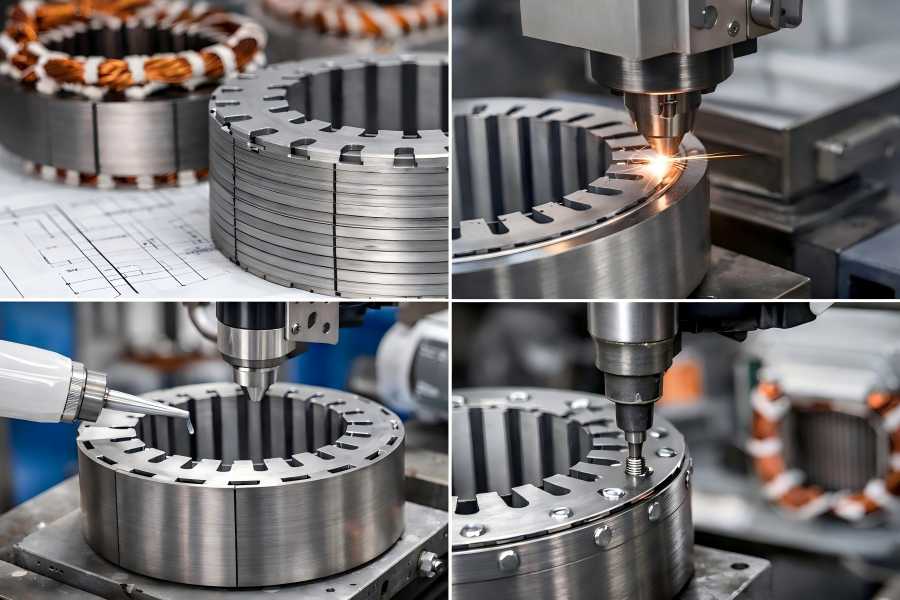
Motor noise and vibration are no longer minor issues that can be hidden by housing design. NVH performance is a crucial sign of quality and dependability in contemporary electric motors.
Beyond electromagnetic design and control strategies, the stator and rotor stacking process plays a crucial yet often overlooked role in influencing motor noise and vibration.
Understanding Noise and Vibration Behavior in Electric Motors
Noise and vibration in electric motors are complex phenomena resulting from the interaction of electromagnetic forces, mechanical structures, and dynamic operating conditions. To appreciate the role of stacking processes, it is important to first understand where noise and vibration originate.
Primary Sources of Motor Noise
Motor noise typically arises from three major sources:
Electromagnetic noise
Electromagnetic noise arises from time-varying magnetic forces between the stator and rotor, caused by flux harmonics, slotting effects, and air-gap non-uniformity. When these forces excite the stator stack’s natural frequencies, audible noise occurs.
Mechanical noise
Mechanical noise originates from bearings, shafts, imbalance, misalignment, and assembly tolerances. Although often treated separately, it is closely related to the rigidity and integrity of the stator and rotor stacks.
Aerodynamic noise
At high speeds, airflow disturbances around rotating parts generate aerodynamic noise. While stacking does not directly affect airflow, poor stacking can amplify this noise by increasing vibration.
Among these sources, electromagnetic noise is the most sensitive to stacking quality, as stacking governs how magnetic forces are distributed and transmitted within the motor structure.
How Vibration Is Generated and Transmitted
Vibration occurs when excitation forces act on motor components and exceed the system’s damping capacity. These forces can originate from electromagnetic harmonics, rotor imbalance, or mechanical defects.
Once generated, vibration propagates through:
- Stator laminations and stack interfaces
- Insulation layers and bonding materials
- Motor housing and mounting structures
The stator stack often acts as the primary vibration radiator. If stacking processes introduce uneven stiffness or residual stress, vibration levels increase and become more difficult to control through external damping.
NVH as a System-Level Outcome
NVH performance is the result of multiple interacting factors, not a single influencing element. Instead, it is the result of interactions among:
- Electromagnetic design
- Mechanical structure
- Manufacturing processes
The stacking process sits at the intersection of these domains, influencing both magnetic behavior and mechanical integrity. Even a well-designed electromagnetic model can fail NVH targets if stacking quality is inadequate.
What Is Motor Stacking?
Motor stacking refers to the assembly of individual electrical steel laminations into a unified stator or rotor core with a defined axial length and mechanical stability.
The stacking process serves several critical functions:
- Establishes the magnetic circuit path
- Defines air-gap geometry and consistency
- Provides structural rigidity
- Enables integration with shafts, housings, and windings
While lamination stamping determines the accuracy of each sheet, stacking determines how these sheets behave collectively under electromagnetic and mechanical loads.
Stator vs. Rotor Stacking
Although the basic principles are similar, stator and rotor stacking have different NVH implications.
Stator stacking
The stator is fixed relative to the housing, making it the primary radiator of noise. Any vibration generated in the stator stack is efficiently transmitted to the external environment.
Rotor stacking
Rotor stacking affects NVH indirectly by influencing balance, eccentricity, and magnetic pull. Poor rotor stacking can excite stator vibration even if the stator itself is well designed.
Both must be carefully controlled to achieve low-noise operation.
Beyond Magnetic Performance
Stacking quality affects more than magnetic efficiency. It also determines:
- Structural damping
- Stress distribution
- Natural frequencies
These factors directly influence how the motor responds to excitation forces and whether those forces become audible noise or damaging vibration.
Key Stacking Parameters That Affect Noise and Vibration
Several stacking-related parameters have a direct and measurable impact on NVH performance.
Stack Alignment and Concentricity
Precise alignment of laminations ensures a uniform air gap between stator and rotor. Misalignment causes:
- Uneven magnetic forces
- Increased radial vibration
- Higher electromagnetic noise
Even small deviations in concentricity can significantly increase noise, especially in high-speed motors.
Stack Length Consistency and Axial Compression
Variations in stack length lead to non-uniform magnetic loading along the motor axis. Excessive axial compression can:
- Reduce inter-lamination damping
- Increase stiffness-related resonance
Insufficient compression allows micro-movements between laminations, generating low-frequency vibration and audible buzzing.
Inter-Lamination Contact and Micro-Gaps
Micro-gaps between laminations reduce structural stiffness and allow relative motion under magnetic forces. This motion:
- Converts electromagnetic energy into vibration
- Produces tonal noise at specific frequencies
Stacking processes that ensure full surface contact generally perform better in NVH testing.
Residual Stress Introduced During Stacking
Residual stress arises from mechanical deformation, thermal input, or uneven pressure during stacking. These stresses:
- Alter magnetic permeability
- Shift natural frequencies
- Increase susceptibility to resonance
Managing residual stress is critical for low-noise motor applications.
Common Motor Stacking Processes Explained
Different stacking processes result in distinct mechanical and acoustic behaviors. Understanding their characteristics is essential for informed process selection.
Interlocking (Self-Locking) Stacking
Interlocking stacking uses stamped features such as tabs, teeth, or notches to mechanically lock laminations together.
Influence on noise and vibration
Interlocking provides good axial stability without additional materials. However, localized deformation at locking points introduces stress concentrations that can distort magnetic flux paths. If not carefully designed, these stress points can increase electromagnetic noise.
Typical applications
Household appliances, industrial motors with moderate NVH requirements, and cost-sensitive applications.
Welding Stacking (Laser or Spot Welding)
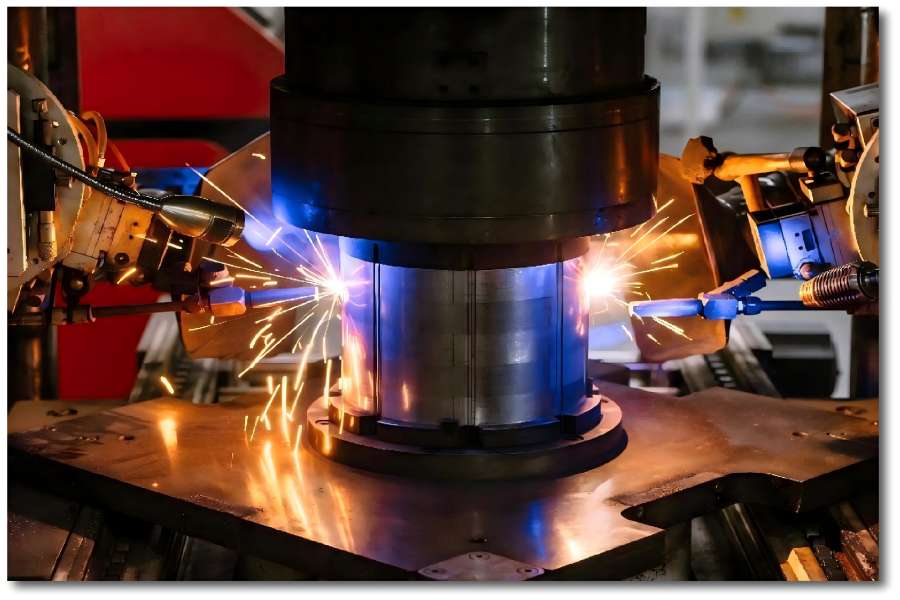
Laminations are welded at specific locations, often on the outer diameter or inner bore. Laser welding is commonly used for precision applications.
Influence on noise and vibration
Welding significantly increases stack rigidity but introduces heat-affected zones and residual stress. These stresses can increase vibration transmission and alter magnetic properties if not properly controlled.
Typical applications
High-speed motors, automotive traction motors, applications requiring high structural strength.
Bonded Stacking (Adhesive or Varnish Bonding)
Laminations are bonded using insulation varnish or structural adhesive, typically cured under controlled pressure and temperature.
Influence on noise and vibration
Bonded stacking provides excellent damping and uniform stress distribution. The bonding layer absorbs vibration energy, reducing noise radiation. However, insufficient bonding strength can compromise stiffness.
Typical applications
Servo motors, medical equipment, robotics, low-noise precision motors.
Riveting and Mechanical Fastening
Mechanical fasteners or rivets clamp laminations together, providing axial compression.
Influence on noise and vibration
Riveting offers stable compression but introduces discrete stiffness points. Over time, vibration may loosen fasteners if not properly designed, affecting long-term NVH stability.
Typical applications
Large industrial motors, legacy designs, low-speed applications.
How Different Stacking Processes Influence Motor Noise
Noise generation is closely linked to how stacking affects magnetic force distribution and structural response.
Electromagnetic Force Harmonics
Stacking irregularities distort air-gap geometry, increasing harmonic content in electromagnetic forces. These harmonics excite stator modes, producing audible noise.
Bonded stacks typically show lower harmonic amplification due to uniform stiffness and damping.
Stack Deformation and Audible Noise
Processes involving high mechanical force or thermal input can warp laminations. Even slight deformation can cause tonal noise, often perceived as whining or humming during operation.
Sensitivity to Speed and Load
At higher speeds, small stacking imperfections become magnified. Welded and interlocked stacks require precise control to avoid noise spikes at certain operating points.
How Stacking Processes Affect Motor Vibration
While noise affects user perception, vibration impacts durability, reliability, and performance.
Structural Stiffness and Vibration Transmission
Welded stacks are stiff and transmit vibration efficiently. Bonded stacks offer better damping but lower stiffness. Selecting the right balance depends on operating speed and load.
Stress Imbalance and Rotor Eccentricity
Uneven stacking stress can cause rotor eccentricity, leading to unbalanced magnetic pull. This produces cyclic vibration that is difficult to eliminate through balancing alone.
Resonance and Natural Frequency Shifts
Stacking processes influence the natural frequencies of the stator core. Poorly matched stiffness can cause resonance within the operating speed range, dramatically increasing vibration levels.
Comparative Analysis
| Stacking Process | Noise Level Tendency | Vibration Damping | Structural Stiffness | NVH Stability |
| Interlocking | Medium | Low | Medium | Moderate |
| Welding | Medium–High | Low | High | Variable |
| Bonded | Low | High | Medium | Excellent |
| Riveting | Medium | Medium | Medium–High | Good |
Application-Specific Stacking Considerations
Different motor applications impose distinct NVH requirements.
Electric Vehicle Traction Motors
EV motors require:
- Very low noise at low speeds
- High stiffness at high torque
Hybrid approaches combining welding and bonding are increasingly used to balance strength and damping.
Servo Motors and Robotics
Precision motion demands minimal vibration. Bonded stacking is often preferred due to superior damping and consistency.
HVAC and Household Appliances
Noise perception strongly influences consumer satisfaction. Optimized interlocking with controlled stress is commonly applied to balance cost and NVH performance.
High-Speed Industrial Motors
Structural integrity is critical. Welded stacking dominates, but careful thermal and stress management is required to control vibration.
How Manufacturers Control Noise and Vibration During Stacking
Leading manufacturers use multiple strategies to reduce NVH risks.
Precision Tooling and Die Design
High-precision dies minimize burrs and deformation, improving stack consistency from the first step.
Controlled Pressure and Curing
Uniform pressure ensures consistent inter-lamination contact, while controlled curing reduces residual stress.
Inline Measurement and Inspection
Laser and vision systems detect alignment, flatness, and stack length deviations in real time.
Post-Stacking Treatments
Stress relief, impregnation, and dynamic balancing further reduce vibration potential.
Choosing the Right Stacking Process for Low-Noise Motors
Selecting the optimal stacking process requires balancing performance, cost, and production scale.
| Design Priority | Recommended Stacking Method |
| Lowest noise | Bonded stacking |
| High-speed durability | Welding or hybrid |
| Cost efficiency | Interlocking |
| Long-term NVH stability | Bonded or riveted |
| Prototype flexibility | Bonded or laser-assisted |